
The storm passed over Allen just after dark, and in the morning your street is full of neighbours checking their roofs from the driveway. Allen roofing is the search most of them will type next, and the direct answer is that most Allen roof work after a storm is repair, not replacement, and it starts with a proper inspection on the roof, not a guess from the ground. Allen is a Collin County suburb north of Dallas, between Plano and McKinney on Highway 75, in the same hail belt as Dallas, under the same summer heat, and under the same Texas rules, so this guide covers repair, replacement, hail damage signs, costs, permits, and how to choose a roofer in Allen, with nothing invented and nothing promised. But how do you know whether your roof needs a repair, a replacement, or nothing at all.
A damaged roof feels worrying because the harm is above your head and out of sight, and every rain makes you wonder how far it has spread while you wait.

This photo shows a skilled worker installing roofing material outdoors. It is the closest real photo available, not an Allen home.
Why Allen Roofs Take a Beating
Allen sits in Collin County, north of Dallas, squarely in the hail belt. Hail season runs from May to September, and the storms arrive with little warning and a lot of ice. In April 2026, baseball size hail fell across Dallas, Tarrant, Collin and Denton counties, and Allen was in the path of that storm system. The DFW 10 year NOAA record shows 2,015 hail reports, with 283 of them 2 inches or larger, and $6.1 billion in reported property damage, more than 10 times any other metro profiled by The Roofing Brief. An Allen roof is storm equipment, and that is the frame for every decision in this guide.
Heat is the second half of the punishment. An Allen summer bakes shingles until they curl and lose granules, and a shingle that has lost its granules has lost its armour against the next hailstorm. Allen was largely developed from the 1990s onward, with family homes in HOA communities such as Twin Creeks, so many roofs in the city are now old enough that age, heat, and hail are arriving together. Knowing what usually fails is the first step, and the next section names it.
The Most Common Allen Roof Problems
Hail bruising is the most common Allen roof problem, and it is also the easiest to miss. A hailstone bruises a shingle by knocking its granules loose and cracking the mat underneath, and the bruise often looks like nothing from the ground. The damage shows up later, as a leak or as granules washing into the gutters. A roof can look fine from the street and still be bruised across a whole slope.
Flashing failure is the second most common problem. Flashing is the metal that seals the joints where the roof meets a wall, a chimney, a vent, or a skylight, and North Texas heat moves the metal while hail dents it, so flashing joints are the first place a good roofer checks on any leak call. Pipe boot failure is the third, because a pipe boot is the rubber collar that seals around a plumbing vent pipe, and Texas sun destroys the rubber over time. A cracked pipe boot lets water run straight down the pipe and into the house. Valley failure is the fourth, because a valley carries more water than any other part of the roof in a hard rain, and nail pops are the fifth, because a nail that has worked its way up through a shingle leaves a small hole that lets water in every time it rains. These are the usual suspects, and a good inspection checks each one, which is what the next section covers.
How to Tell If Your Allen Roof Has Hail Damage
Start from the ground, and look for the signs you can see without climbing. Check the gutters and downspouts for granules, because a shingle that has lost granules to hail sheds them into the gutter, and a gutter full of granules after a storm is a warning. Look at the metal around the house, the gutters, the downspouts, the air conditioning unit, and the mailbox, because hail that dents soft metal has usually hit the roof too. Look for shingles that are cracked, curled, or missing, and for dark spots where granules are gone.
What you cannot see from the ground matters more. A bruised shingle feels soft when it is pressed, and the bruise is found by touch, not by sight, which is why a proper inspection happens on the roof, not from the driveway. A roofer who inspects an Allen roof after hail should walk the slopes, press the shingles, check the flashing, valleys, and pipe boots, and look in the attic for damp decking. Our guide on how to tell if your roof has hail damage in Dallas walks through the signs in full, and the same signs apply in Allen, because the hail belt does not stop at a city line. A roofer who promises a verdict from the ground in ten minutes is guessing, and guessing with your roof is expensive. Once you know whether the roof is damaged, the question is what the fix looks like, and that is next.
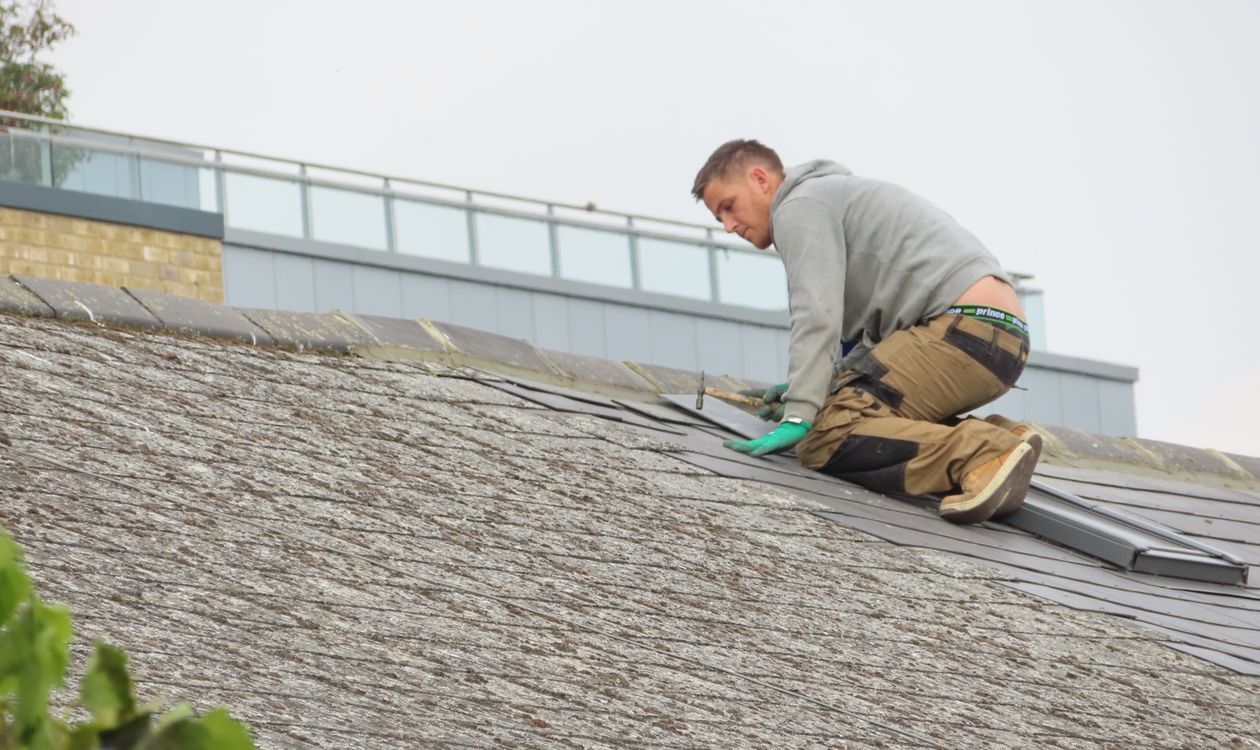
This photo shows a construction worker installing shingles on a rooftop. It is the closest real photo available, not an Allen roof.
Allen Roof Repair: What Gets Fixed
Most Allen roof work is repair, and most repairs fix one of the usual suspects. A failed pipe boot gets replaced, not smeared with sealant, and replacing a pipe boot is quick work, one of the best value repairs on an Allen roof. Failed flashing gets replaced with new metal that overlaps correctly, not just sealed over the old piece, because sealant alone is a temporary fix on a joint that moves with heat. A damaged valley gets new flashing and clear water flow, not a patch laid over debris. Shingles around the repair get replaced with matching shingles, sealed properly, so the repair blends into the roof.
There is no single price for roof repair allen homeowners face, and any guide that gives you one number is guessing. The cost changes with the cause, how easy the roof is to reach, and what is found underneath once the damaged area is opened up. Before you agree to a price, get it in writing, with the work listed and the warranty stated. A quote that is far below the others usually leaves something out. Our guide to roof repair in Dallas explains what a good post storm inspection covers, and the same standard applies in Allen. Repair is enough when the damage is local, but sometimes it is not, and that is the next decision.
When an Allen Roof Needs Replacing Instead
Repair is enough when the damage is local and the rest of the roof is sound. One failed pipe boot, one section of flashing, or a handful of bruised shingles after a storm are repair jobs, and a good repair will last. The roof around the repair should be in good shape, with shingles that still have granules, flashing that is sound elsewhere, and a deck that is dry and firm.
Replacement starts making sense when the damage is spread across the whole roof. Shingles losing granules everywhere, shingles curling or cracking across several slopes, flashing failing at several joints at once, a deck that is soft in more than one place, or repairs that keep coming back in new spots every year, these are signs the roof as a system is at the end of its life. Age matters too, because a roof near the end of its expected life is usually better replaced than repaired in pieces. For scale, the average Dallas roof replacement costs $10,000 to $15,000, with larger homes at $16,000 to $24,000, according to the Wortham Brothers 2026 guide, and the Angi Dallas average is $10,054. Those are published averages for the Dallas area, not quotes, and an allen roof replacement will differ with the size, slope, and material of your own roof. Our guide to Dallas roof replacement walks through the full cost picture. A replacement is also the moment permits and Texas rules come into play, and those are next.
Permits and Rules for Roofing in Allen
Roofing in Allen is regulated locally through city permits, because Texas issues no state roofing licence. A full replacement or a large reroof area needs a permit through the city permit process, while minor repairs usually do not, and your roofer should handle the permit and show it to you before work starts on anything larger than a patch. Permit details change, so the roofer doing the work should confirm the current requirement with the city before the job starts. A roofer who will not pull a permit for a full replacement is a roofer to walk away from.
Three Texas rules protect you, and a good Allen roofing contractor will know all three without being told. A contractor may not waive, rebate, or absorb your insurance deductible, under Insurance Code 707.002, and it is a crime to offer it, so a roofer who offers to cover your deductible is a warning sign, not a favour. A contractor may not act as a public adjuster on a job it also repairs, under Insurance Code 4102.163, which keeps the roles separate. And an insurer must acknowledge a claim within 15 business days, under Insurance Code 542.055, which is a timeline for the insurer to respond, not a promise about what the claim will pay. Keep a record of every call, every visit, and every document, with dates and names, because a clear record makes a claim move faster. With the rules understood, the last decision is who does the work.
How to Choose an Allen Roofing Contractor
Allen has established local roofers with long histories, and that is a good place to start. Pickle Roofing Solutions has been based in Allen since 2012, it is family owned, it was founded by Randy Pickle, and it holds GAF Master Elite certification. Legacy Roofing and Construction also serves Allen, and it states 20 years of roofing and construction experience on its own site. Judge the roofer on their own record, not on their website. Ask how long they have worked in Collin County, ask for photos of finished work nearby, and ask for the scope in writing before work starts.
Choose a contractor who inspects before quoting, lists the work, materials, and warranty in writing, and carries insurance and will show proof. Be wary of a contractor who knocks on your door the day after a storm and pressures you to sign on the spot, who demands full payment upfront, or who offers to cover your deductible, because the best crews in the area are busy after hail, and they do not need to pressure anyone. If water is coming in right now, do not wait for a quote, get the roof tarped first, then get the inspection done. An Allen roof that is inspected, repaired properly, and checked twice a year will serve its home well for years, so the final questions are the simple ones, and they are below.
Frequently Asked Questions
How do I know if my Allen roof has hail damage?
Look for granules in the gutters, dents in soft metal around the house, and shingles that are cracked, curled, or missing. The damage that matters most is often invisible from the ground, because a bruised shingle feels soft when pressed, so a proper inspection happens on the roof, checking shingles, flashing, valleys, and pipe boots.
How much does roof repair cost in Allen?
There is no single price, because the cost changes with the cause, how easy the roof is to reach, and what is found underneath. Get the work listed in writing, with the warranty stated, before you agree to a price. For scale on a full replacement, the average Dallas roof replacement costs $10,000 to $15,000, with larger homes at $16,000 to $24,000, according to the Wortham Brothers 2026 guide, and the Angi Dallas average is $10,054.
Do I need a permit for roof work in Allen?
A full replacement or a large reroof area needs a permit through the city permit process, while minor repairs usually do not, and roofing in Allen is regulated locally through city permits, because Texas issues no state roofing licence. Your roofer should handle the permit and confirm the current requirement with the city before work starts.
Can a roofing contractor waive my deductible in Allen?
No. A contractor may not waive, rebate, or absorb your insurance deductible, under Texas Insurance Code 707.002, and it is a crime to offer it. A roofer who offers to cover your deductible is a warning sign, not a favour, and you should walk away from that offer.
Should I repair or replace my Allen roof after hail?
Repair is enough when the damage is local and the rest of the roof is sound. Replacement makes sense when the damage is spread across the whole roof, the shingles are losing granules everywhere, or repairs keep coming back in new spots every year. Age matters too, because a roof near the end of its life is usually better replaced than repaired in pieces.