
The hail has just passed, and now water is coming through the ceiling. If your roof has storm damage in Dallas, the order you do things in matters, for your safety and for your insurance claim. The direct answer is to stay safe first, take photos of everything, get the openings tarped, and then get a proper inspection and written bids for the permanent repair, because damage from a sudden event such as hail or wind is often covered, subject to your policy and deductible, while wear and age generally are not.
Water coming into your own home is frightening, and the worst part is not knowing whether the roof is safe, whether the damage is spreading, or who to trust to fix it.
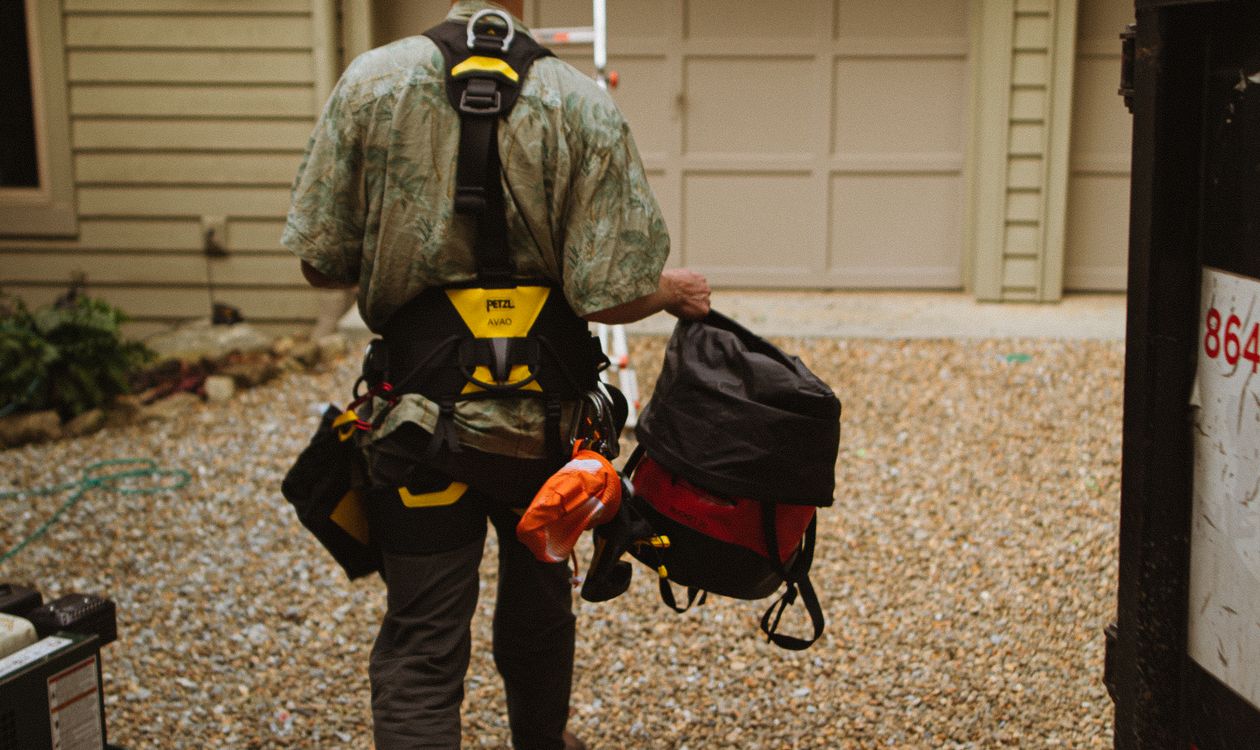
This photo shows a worker with safety gear and tools walking towards a roof for repair. It is the closest real photo available, not a Dallas storm job.
First, Make It Safe
Before anything else, keep people out from under a sagging ceiling, and keep water away from power. If a ceiling is bulging or sagging with trapped water, stay out of the room, because a waterlogged ceiling can come down without warning. If water is running near light fittings, switches, or outlets, do not touch them, and keep clear until the power to that area is off. Move valuables, furniture, and electronics away from the leak, and put buckets or towels down to catch the water, but do not climb onto a wet roof yourself, because a wet roof is slippery, damaged decking can give way underfoot, and a fall from a roof is far worse than a leak.
Safety comes before the claim and before the repair, and no photo is worth a fall. Once everyone is safe and the water is contained as far as you can from inside, the next job is to limit the damage, because every hour water keeps coming in adds to the repair bill. That is the next section.
Limit the Damage
The first practical step is to get the openings covered. Have holes in the roof covered with a tarp until a permanent repair is done, because a tarp stops the rain getting in while you sort out the inspection and the claim. A professional roof tarp typically costs $175 to $700, and published Dallas Fort Worth tarp prices run about $200 to $500. The City of Dallas says no permit is needed for temporary measures such as tarps, so a tarp can go up straight away, and that is the point, because a tarp today can save a ceiling, a floor, and a room full of insulation tomorrow.
Before anything is moved or covered, take photos of everything, the roof from the ground, the water inside, the damaged rooms, and anything the storm broke or moved. Photos taken before and after a storm can make an insurance claim smoother, and photos taken after the damage but before the tarp goes on are the ones that show what the storm actually did. Do not throw damaged materials away until the claim is sorted, because the adjuster may need to see them. Keep a note of the date and time of the storm, and of everything you do afterwards, because a clear record is what makes a claim move. With the damage limited and documented, the next question is what the storm actually did to the roof, and that is often more than it looks like from the ground.
What Hail and Wind Actually Do to a Dallas Roof
Dallas sits in the heart of hail alley, and the Dallas Fort Worth area averages 4 to 6 significant hail events per year. Every spring, severe storms drive hail and high winds across the Dallas area, and a single storm can crack pipe boots, lift shingles, and open flashing on a roof that looked fine the week before. The Dallas Fort Worth area recorded 2,015 hail reports over a recent 10 year period tracked by NOAA, with 283 of them at 2 inches or larger, and $6.1 billion in reported property damage. In April 2026, baseball size hail fell across Dallas, Tarrant, Collin and Denton counties, followed by more storms in May, and roofs across the city were damaged in a single afternoon.
Hail damage often cannot be seen from the ground. Look for cracked shingles, lost granules, soft spots where the shingle mat has been bruised, dents in flashing and vents, and shingles lifted or missing after wind. A bruised shingle can look fine from the driveway and still let water through, because the hail has broken the mat underneath the surface. Wind does its own damage, lifting shingle edges, peeling back ridge caps, and driving rain under flashing that was sound before the storm. The June 13, 2012 storm is the example Dallas roofers still talk about, with hail up to 4.25 inches, softball size, falling on parts of Dallas and Collin counties, and early damage estimates near $900 million. Four of the six costliest hailstorms in Texas history hit North Texas, including the May 5, 1995 Mayfest storm at $1.62 billion in 2013 dollars. That history is why a Dallas roof needs a proper inspection after any serious storm, not just a look from the driveway, and the inspection is what the claim rests on.
This photo shows rain falling on a rainy spring day. It is the closest real photo available, not a Dallas storm.
Document Everything for the Claim
For storm damage claims, you should document damage and work directly with your adjuster, and the documentation starts the day of the storm. Take wide photos of each roof slope from the ground, close photos of any visible damage, photos of the water inside, and photos of anything else the storm damaged, such as gutters, vents, fences, and cars. Note the date and time of the storm, keep the photos in one place with the date on them, and keep a record of every call, every email, and every visit, with dates and names.
Call your insurer promptly, because Texas policies generally require prompt notice after a storm event, and delays can give carriers grounds to argue additional deterioration was caused by neglect rather than the original storm. Under Texas law, an insurer must acknowledge a claim within 15 business days, under Insurance Code 542.055. That is a timeline for the insurer to respond, not a promise about what the claim will pay. A good roofer will document the damage with photos and measurements, meet your adjuster on the roof if you want them there, and give you a written repair scope you can share with your carrier. If water is coming in now, our guide to emergency roof repair in Dallas explains what to do first, and the permanent repair follows once the roof is dry and the claim is moving. The next question is whether the storm damage is a repair or a replacement, and the answer depends on how far the damage reaches.
Repair or Replace After a Storm
Repair when the damage is limited to one area and the rest of the roof is sound. A few cracked shingles, minor flashing damage, or isolated impact marks can be fixed without replacing a whole section, and a repair that fixes the actual damage will hold. Replace when hail has damaged several slopes, when the shingles are losing granules everywhere, when flashing is damaged at several joints at once, or when the roof has needed repeated repairs. In those cases the roof as a system is failing, and patching one slope leaves the next storm to finish the rest.
Our guide to roof repair versus replacement in Dallas walks through the comparison in full, and the honest rule is simple. If the damage is spread across the whole roof, replacement is usually the better choice, because each new repair lands on a roof that is getting weaker underneath. If the damage is local, a good repair is the right call, and it will last. Age matters too. A roof near the end of its expected life that has storm damage across several slopes is usually better replaced than repaired in pieces, because the next hail season will find the same weak roof again. Cost is the question that follows, so here is what storm repair costs in Dallas.
What Storm Damage Repair Costs in Dallas
There is no single price for storm damage repair, and any guide that gives you one number is guessing. The cost changes with how much of the roof is damaged, the type of roofing, how easy the roof is to reach, and what is found underneath. For scale, Angi puts Dallas hail damage repairs at about $700 to $4,000. A Fort Worth roofer lists minor hail repairs on one small section at $300 to $1,500 and larger sections at $1,500 to $4,000, and a Dallas Fort Worth roofer lists minor shingle or seal repairs at $150 to $500. The average roof repair in Dallas costs $657, with most homeowners paying between $262 and $1,081, according to Angi. Those are published figures, not quotes, and your roof will differ.
What matters is what your quote includes. A written quote should say what will be done, how large the repair area is, whether tear off and disposal are included, whether the deck is included if it proves wet, and what the warranty covers. A quote that is far below the others usually leaves something out, and that something is often the deck or the flashing. If the damage came from a storm, the claim and the quote go together, so get the written scope before any permanent work starts, and keep it with the photos and the claim record. The work also needs the right permissions, so those are next.
Permits After a Storm
The City of Dallas says no permit is needed for temporary measures such as tarps, while storm repairs to shingles and deck can need a roofing permit, and damage to joists or rafters needs a building permit. That means the tarp goes up straight away, and the permanent repair waits for the permit where one is needed. Suburbs set their own rules, so check your own city before work starts, because a repair that needs a permit in one suburb may not need one in the next.
Your roofer should handle the permit, and you should see it before work starts on anything larger than a patch. Small repairs usually do not need a permit, while Dallas requires a reroof permit for large areas or a full replacement. A roofer who will not pull the permit, or who tells you not to bother, is a roofer to avoid, because unpermitted work can cause problems with your insurer and with a future sale. The last choice is who does the work, and after a storm that choice matters more than ever.
Choosing Who Does the Work
After big hail events, Dallas fills with out of area crews who sign roofs and leave, and a storm repair is the worst job to hand to a crew you will never find again. Choose a roofing company with a physical office in the Dallas Fort Worth area, a verifiable business history, and staff who will still be here next year. Check that the roofer carries general liability insurance and workers compensation coverage, ask for references from Dallas homeowners, and get at least three written quotes on the same scope before you sign.
Watch for the red flags. A contractor may not waive, rebate, or absorb your insurance deductible, under Insurance Code 707.002, and it is a crime to offer it. If a roofer offers to cover your deductible, that is a warning sign, not a favour. A contractor may also not act as a public adjuster on a job it also repairs, under Insurance Code 4102.163, which keeps the roles separate. A roofer who pressures you to sign today, who has no local address, or who cannot show you local work is a roofer to walk away from. Our guide on how to tell if your roof has hail damage in Dallas explains what hail damage looks like, and a storm repair deserves the same clear scope, the same written quote, and the same careful check in the next rain.
Tip: After the storm, photograph the roof from the ground before anyone climbs up or tarps anything, and keep those photos with the date on them. They are the clearest proof of what the storm did, and they are what your adjuster will ask for first.
Frequently Asked Questions
What should I do first after hail damages my roof in Dallas?
Stay safe first, keep people out from under a sagging ceiling and water away from power. Then take photos of everything, get the openings tarped, and call your insurer promptly. A professional roof tarp typically costs $175 to $700, and the City of Dallas needs no permit for a temporary tarp, so it can go up straight away.
Will insurance cover storm damage to my roof?
Damage from a sudden event such as hail or wind is often covered, subject to your policy and deductible, while wear and age generally are not. Call your insurer promptly after the storm, because delays can give carriers grounds to argue additional deterioration was caused by neglect. Your insurer must acknowledge a claim within 15 business days under Insurance Code 542.055.
How long do I have to file a storm damage roof claim?
Texas policies generally require prompt notice after a storm event, so call your insurer as soon as you find the damage. There is no fixed number of days in the policy that fits every case, but waiting weeks gives the carrier room to argue the damage got worse because it was left alone, so the safe rule is to report it the day you find it.
Can a roofer waive my insurance deductible?
No. A contractor may not waive, rebate, or absorb your insurance deductible, under Insurance Code 707.002, and it is a crime to offer it. If a roofer offers to cover your deductible, that is a warning sign, not a favour, and you should walk away.