
Your tile roof looks perfect from the street. The barrel tiles curve in neat rows, the color still looks rich, and nothing about the house says trouble. Then a brown stain appears on the ceiling, and the roofer tells you the tile is fine but the roof is leaking anyway. That is the confusing truth about tile roofing dallas homeowners discover the hard way: the tile is almost never the problem. The waterproofing layer underneath it is. This guide promises the full picture, what tile costs here, which type survives Texas hail, why a fifty year tile sits on a twenty five year felt, and when the right job is a repair, a relay, or a full replacement. So what really decides whether a tile roof is worth it on your house? The direct answer is that tile wins on looks and long life, and it only makes sense when the house is framed to carry it, the underlayment is sound, and you plan to stay long enough for the high start price to pay you back.
That worry is fair. A tile roof is the most expensive roof most Dallas homes will ever wear, and nobody wants to learn its weak spot from a ceiling stain.
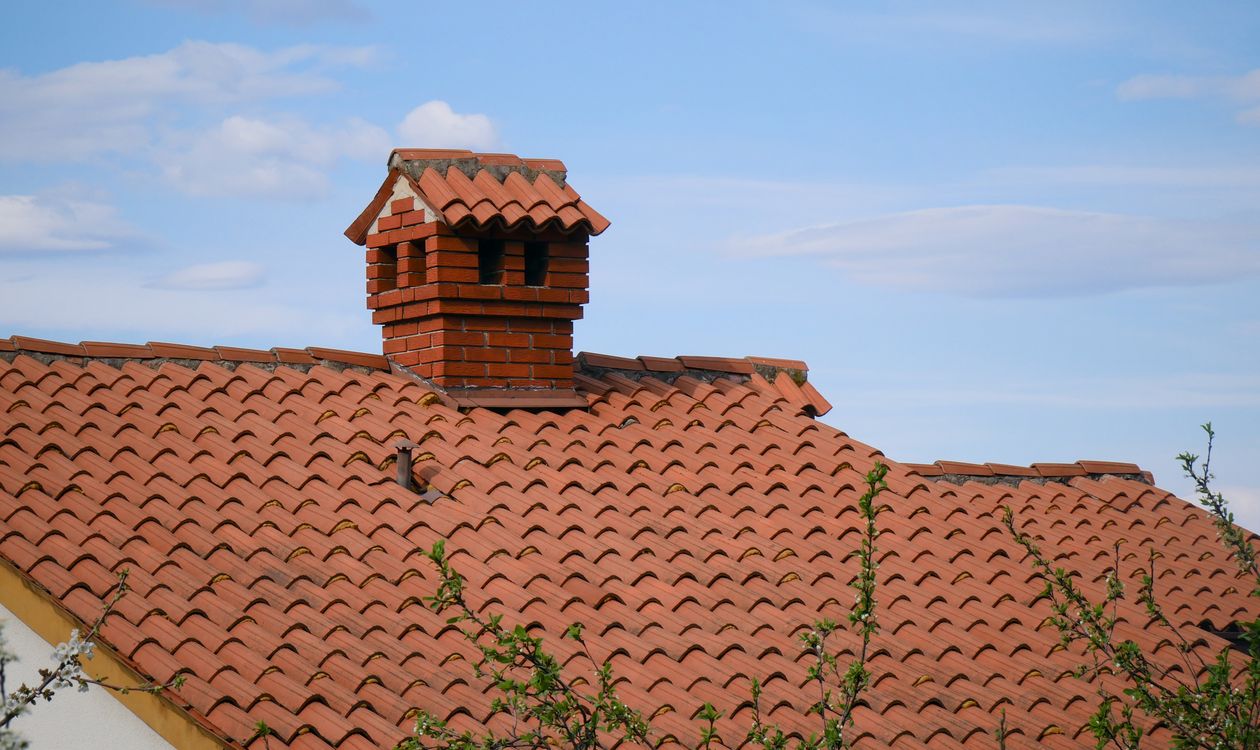
A red brick chimney stands atop a detailed clay tiled roof under a clear blue sky. The tile is the visible layer, not the waterproofing layer.
How a Tile Roof Really Works
A tile roof works in two layers, and only one of them keeps water out. The tile is the outer shield. It sheds most of the rain, takes the sun, and gives the house its look. The underlayment beneath it is the real waterproofing, a felt or synthetic sheet laid over the deck that catches whatever water gets past the tile. Tile only sheds most of the water, as the Dallas tile specialists put it, and the underlayment handles the rest. That is why a roof can look perfect from the street while water runs underneath it, and why every tile guide in Dallas starts with the same warning: the tile rarely fails, the underlayment does.
Once you see the roof as two layers, the choice of tile becomes clearer, so let us compare the two types Dallas homes actually use.
Concrete Tile or Clay Tile
Dallas tile roofs are almost always concrete or clay, and the two differ on weight, hail, color and price. Concrete tile comes in flat, low profile and barrel shapes, with color mixed through the tile rather than painted on, and most makers give it a Class 4 impact rating. Clay tile is fired, so its color never fades, and it is the tile on the Spanish style and Mediterranean style homes in north Dallas. Clay costs more per square and takes longer to lay, and it is more brittle under hail and under a careless boot. Clay is installed in two piece pan and cover or one piece S profiles, with birdstop at the eaves, and ridge and rake tiles set in color matched mortar or on foam adhesive.
| Concrete tile | Clay tile | |
|---|---|---|
| Weight | 9 to 12 lb per sq ft | 6 to 10 lb per sq ft |
| Hail | Class 4 rated from most makers | Brittle under large hail |
| Color and cost | Color through the mix, lower cost | Fired in color that never fades, higher cost |
Concrete is the more common choice in Dallas Fort Worth, and it is generally more affordable. Clay is the classic choice where the look matters most and the budget allows it. There is one disagreement worth knowing. One Dallas guide says concrete color runs through the mix, while another says concrete loses surface color after twenty Texas summers. Both can be true at once, because color through the mix still weathers and fades slowly in Dallas sun, while clay keeps its fired color for the life of the roof. If lasting color matters to you, clay has the edge, and if budget matters more, concrete does. A third option exists where weight matters: composite tile, made to look like clay or slate while weighing far less, and laid where a real tile roof would be too heavy for the framing.
Either tile only works if the house can carry it, and that is the question most buyers forget to ask.
The Weight Question, Can Your House Carry Tile
Tile is heavy, and that fact decides more tile jobs than any other. Published Dallas figures put concrete tile at nine to twelve pounds a square foot, and clay at six to ten pounds a square foot, while another Dallas guide puts clay at 900 to 1,100 pounds a square, which works out to about nine to eleven pounds a square foot. The two sources disagree slightly on clay, so treat the range as nine to twelve pounds a square foot for planning and let the framing check settle it. Asphalt shingles, by comparison, weigh roughly two and a half to four pounds a square foot, so tile is roughly three to four times heavier than the roof most Dallas houses were built with.
A house framed for shingles was framed for about a quarter of that weight, so a tile conversion starts in the attic, with a tape measure on rafter size, spacing and span. A home not built for tile needs an engineer before any order, and usually added rafters. That check is not a formality. It is the difference between a roof that lasts fifty years and a structure that sags under it. New tile also needs the right slope, with most tile needing a pitch of at least four in twelve, and the right fastening for the pitch. If your house was built for tile, none of this is a problem, and the weight becomes a strength, because heavy tile resists wind lift better than a light roof.
Weight decides whether tile is even possible, and hail decides whether it is wise, so that comes next.
Hail in Dallas, What Tile Actually Survives
Dallas sits in one of the hardest hail belts in the country, and the numbers prove it. The ten year NOAA record for Dallas Fort Worth shows 2,015 hail reports, 283 of them two inches or larger, and 6.1 billion dollars in reported property damage. April 2026 brought baseball size hail across Dallas, Tarrant, Collin and Denton counties, with more storms following in May. That storm is the real example behind this whole guide, because a tile roof in Dallas is judged on the worst afternoon of the year, not on a calm day.
Concrete and clay behave differently under hail. Newer concrete tile carries a Class 4 impact rating from most makers, and one Dallas roofer reports that concrete tiles handle hail of one and a half to two inches without damage, while larger hail of two and a half inches or more can crack tiles, especially flat profiles. Clay is more brittle. Large hail cracks clay and older concrete, and a spring storm usually leaves a few cracked covers on the storm facing slope. Tile can crack under impact, and no tile roof is hail proof, so an inspection after a big storm still matters even when the roof looks fine from the driveway. If hail has already hit your home, read our guide to how to tell if your roof has hail damage in Dallas before you call anyone, so you know what to document.
Hail breaks tiles one at a time, but heat and age break the layer underneath, and that failure is quieter and more expensive.
The Underlayment Clock, Fifty Year Tile on Twenty Five Year Felt
Here is the fact every Dallas tile owner eventually learns. The tile can last fifty years or more, but the underlayment beneath it does not. Published Dallas figures disagree on exactly how long it lasts, and the disagreement is worth stating plainly. One Dallas tile guide puts the underlayment at about twenty five years. Another puts felt underlayment at twelve to twenty years and high temperature synthetic underlayment at twenty five to thirty plus years. A third puts underlayment failure at the twenty to twenty five year mark. The honest reading is that felt lasts roughly twelve to twenty years in Dallas heat, synthetic lasts roughly twenty five to thirty plus years, and the tile above them both can last fifty years or more.
Dallas heat is what runs the clock down. Attic temperatures reach 150 degrees or more, which dries out low grade underlayment quickly, and felt underlayment dries out, cracks, and lets water reach the decking. That is why a tile roof over twenty years old deserves an underlayment check even when the tile looks perfect. A roofer lifts a few tiles, looks underneath, and says whether the job is a repair, a relay, or nothing at all. The warning signs are leaks that keep coming back in the same place, tiles slipping across whole sections, and damp decking under a roof that looks fine from the street.
When the underlayment is the problem, the fix has a name most homeowners have never heard, and it saves far more than a new roof.
The Relay Job, the Fix Most Tile Owners Eventually Need
A relay is the job most tile owners in Dallas eventually need, and it is simpler than it sounds. The tiles come off in sections and are stacked on the roof, the old felt is stripped, the decking is repaired where it has softened, and a new high temperature synthetic underlayment goes down with new valley metal, pipe flashings and drip edge. The original tile goes back on, with new tiles swapped in for any that cracked. The roof looks the same and is good for another thirty years, according to the Dallas guide that describes the job. A tile only relay with new underlayment, keeping the existing tiles, saves thirty to forty percent against a full replacement, according to another Dallas roofer, and it typically completes in four to seven working days, against five to ten working days for a full tile replacement.
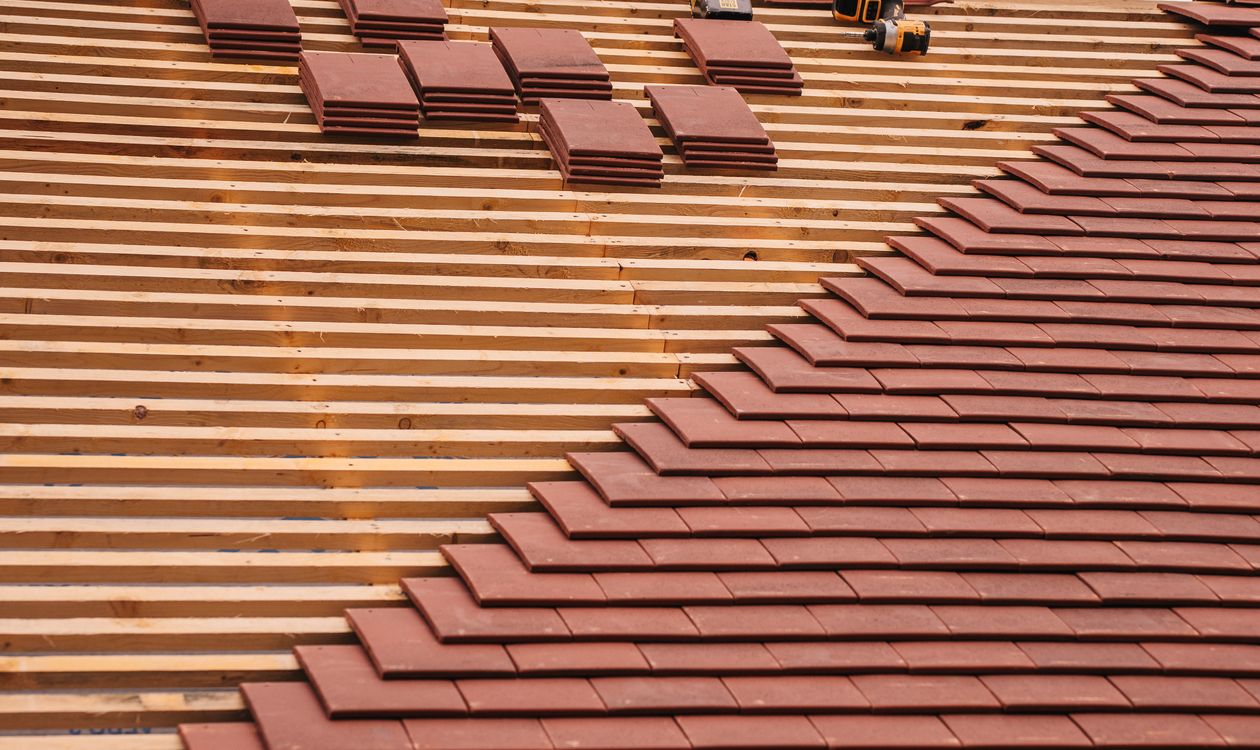
Terracotta tile being laid during a roof job. A relay lifts the tile, renews the layer beneath it, and lays the same tile back.
A relay also needs a Dallas reroof permit, because it counts as a full reroof in the eyes of the city, and the permit and inspection are part of the job. The same goes for matching. Discontinued profiles are matched from salvage stock or from tiles moved from a hidden slope, because weathered clay and old tile do not come out of a catalog. If your tile is still made, matching is easy. If it is not, salvage is the answer, and a good tile roofer keeps salvage stock for older profiles.
A relay is the big job, but most tile problems are small, and small jobs have their own rules.
Tile Roof Repairs in Dallas
Most tile repairs are small, and they follow a pattern Dallas tile specialists repeat on every page. Cracked or broken tiles come from hail, tree branches, or foot traffic. Slipped or displaced tiles come from improper fastening, wind lift, or aging battens. Flashing fails at walls, chimneys, skylights and valleys, which are the most common leak points in Dallas area homes. Valley debris builds up, traps moisture, and speeds underlayment rot. And poor repairs from earlier contractors, tar, caulk, or the wrong tile patched in, create new leaks on top of the old one.
Published Dallas repair ranges, framed as planning figures that vary by job, put a cracked tile replacement at $25 to $75 per tile depending on availability, a small leak repair at $450 to $1,200, a valley or flashing repair at $800 to $2,500, and a sectional underlayment replacement at $1,500 to $5,000. A repair visit usually replaces a handful of tiles and checks the underlayment beneath them. The repair itself has one rule that matters more than any other: walk the roof the right way. Tile breaks under a careless boot, so a good crew walks on the low edge of each course and on foam pads, because the repair should not create three new breaks on the way to fixing one. Most breaks on a tile roof come from foot traffic, not from weather, so never let anyone walk your tile roof without asking how they will step.
Repairs fix the tile, but the price of a whole tile roof is a different question, so let us look at what it actually costs.
What a Tile Roof Costs in Dallas
Tile sits just below slate on price, and published Dallas ranges disagree in a way worth stating plainly. One Dallas guide puts tile at about $1,000 to $2,000 per square, and tile and synthetic slate at $10 to $20 per square foot. Another Dallas guide puts a tile roof at $27,404 to $37,076 for a 2,000 square foot home, and at $24,800 to $39,680 installed. Those figures measure different things, one by the square and one by the whole roof, and your roof size, pitch, layers and decking condition move the total either way. Treat them as planning ranges, not quotes, and get a written quote for your exact roof.
What moves the price is the tile type, the framing check, the profile, and the access. Clay costs more per square and takes longer to lay than concrete. Barrel profiles use more trim tile at hips and ridges than flat tile. A relay budgets a percentage of tiles to replace, because some always break on the way off and back on. Steep pitch and two story eaves slow the stacking and carry. And a relay costs far less than new tile, because the tile is reused and only the underlayment and flashings are new. Against shingles, tile costs far more at the start, roughly two to three times a typical architectural shingle replacement, and the case for tile is that it lasts more than twice as long.
Cost only makes sense next to the other materials, so here is tile against shingles and metal.
Tile vs Shingles vs Metal in Dallas
Tile, shingles and metal each win on something different, and the honest comparison starts there. Shingles are the cheapest at the start and the easiest to repair, with architectural shingles lasting roughly twenty five to thirty years in Dallas and costing far less than tile. Metal sits between tile and shingles on price, lasts forty years or more, and dents under hail instead of cracking. Tile lasts the longest, fifty years or more, looks the most distinctive, and carries the most weight, which means it needs a house framed for it.
Heat favors tile and metal over shingles, because tile gives excellent thermal mass for hot climates and metal reflects heat, while shingles absorb it. Hail favors concrete tile and metal over clay and standard shingles, because concrete tile carries a Class 4 rating and metal dents instead of cracking, while clay is brittle and shingles bruise. Looks favor tile on Mediterranean style and Spanish style homes, where tile is part of the architecture, not just a covering. Tile also carries a Class A fire rating, the highest available, which matters on a roof that sits over everything you own. Our guide to metal roof vs shingles in Texas compares the other two materials in full, and it is worth reading before you decide, because the right roof is the one that fits your house, your budget, and how long you plan to stay.
The material choice is yours, but the rules around the work are not, and Texas has a few worth knowing.
Permits, Insurance and Texas Rules
Dallas requires a reroof permit for large areas or a full replacement, and a relay counts as a full reroof, so the permit is pulled before work starts. The permit fee for a typical residential reroof runs $175 to $375 depending on roof area and total project value, according to a Dallas materials guide, and the city inspects after tear off for a deck inspection and again after the new system is in place. Dallas also requires a secondary water barrier on all reroofs, which is more than felt or synthetic underlayment alone, and most reputable Dallas roofers install a self adhered membrane or a fully bonded underlayment system as a matter of course.
Texas issues no state roofing licence, and Dallas does not require a city licence either, so the threshold to start roofing here is business registration, liability insurance, and the willingness to pull permits. Vetting falls entirely on you, which is why local references and recent tile work in your area matter more than any card. Insurance has its own Texas rules. A contractor may not waive, rebate, or absorb your insurance deductible, under Texas Insurance Code 707.002, and it is a crime to offer it. A contractor may not act as a public adjuster on a job it also repairs, under Insurance Code 4102.163. Your insurer must acknowledge a claim within 15 business days under Insurance Code 542.055. And never let anyone promise what insurance will pay, because the adjuster decides that, not the roofer.
With the rules understood, the last step is the decision itself.
How to Choose, and How to Keep a Tile Roof
Choose by your own house, not by what a neighbour chose. If your house was built for tile and you plan to stay for decades, tile earns its high start price through a fifty year life and a look no other roof matches. If your house was built for shingles, tile means an engineer, added framing, and a much bigger bill, and a Class 4 shingle or a standing seam metal roof may serve you better for less money. If the roof is over twenty years old and leaking, get the underlayment checked before you spend anything on tiles, because a relay may be the whole answer. And if the damage is a few cracked tiles on one slope, a repair is the right call, while widespread bruising across several slopes points to a bigger job. Our guide to roof repair vs replacement in Dallas walks through that decision in full.
Keeping a tile roof is mostly about leaving it alone and looking at it twice a year. Check it in spring before hail season and in autumn after the heat, and again after any storm that drops hail or brings strong wind. Keep valleys clear, because leaves and debris trap moisture and speed underlayment rot. Never pressure wash tile, and never let anyone walk it without foam pads and a careful step. Get a photo documented inspection every few years, because the underlayment fails silently and the tile above it hides the damage until water shows up inside.
Tip: If your tile roof is over twenty years old, ask a tile roofer to lift a few tiles and photograph the underlayment before you spend a dollar on repairs. That one look tells you whether the job is a repair, a relay, or nothing at all.
Frequently Asked Questions
How long does a tile roof last in Dallas?
The tile lasts fifty years or more, while the underlayment beneath it lasts about twenty five years for synthetic, and twelve to twenty years for felt. The tile rarely fails, the underlayment does, and a relay renews it.
Can hail break a tile roof?
Large hail cracks clay and older concrete, while newer concrete tile carries a Class 4 impact rating and handles hail of one and a half to two inches without damage. No tile roof is hail proof, so an inspection after a big storm still matters.
Can I put tile on a house built for shingles?
Only after an engineer confirms the framing, usually with added rafters, because tile weighs roughly three to four times as much as shingles. A house framed for shingles was framed for about a quarter of the weight tile needs.
What does a tile roof cost in Dallas?
Published Dallas ranges put tile at about $1,000 to $2,000 per square, and at $24,800 to $39,680 installed for a typical home. The total varies with roof size, pitch, tile type and decking condition, so get a written quote for your exact roof.
A tile roof is the longest lived roof a Dallas home can wear, and it is also the heaviest and the most misunderstood. The tile is not the waterproofing, the underlayment is, and the smartest money on a tile roof goes to the layer nobody sees. To compare the other choices, read our guide to metal roof vs shingles in Texas and our guide to roof repair vs replacement in Dallas before you sign anything.